Duane Schuler and Robert Shook met in 1983 while they were each lighting productions in the Civic Opera House building and initially ran separate part-time ventures in Minneapolis and Chicago. United by shared experience and frustration with poorly designed theatres, their hands-on work shaped a clear vision for better performance spaces, leading to the founding of Schuler & Shook, Inc. in 1986.
In 1986, two designers came together with a vision and a plan:
“If the phone rings, answer it.”
And they did just that.

Forty years later, the phone is still ringing, and that scrappy design firm has grown into a globally recognized leader in architectural lighting design, theatre planning, and audio video design.
As we mark this milestone, we look back with pride on our journey, our many collaborations, and the transformative projects we’ve been privileged to help bring to life.
The 80s:
Big Glasses,
Big Hair,
and an Even Bigger Idea

Photo of the founders from a feature article in Crain’s Business Chicago.
Schuler Shook’s formation was less a grand plan and more a gradual evolution.
Duane and Bob describe starting the firm almost by accident — driven by a series of projects and collaborations rather than a formal strategy.
One such project that set the trajectory for the company was a lighting design for an unusual end user: aardvarks.

Aardvark House at Brookfield Zoo:
The Aardvark House at Brookfield Zoo was one of Bob and Duane’s first collaborations and an important step toward forming Schuler Shook.
Tasked with creating a “day-for-night” lighting scheme, they designed a system that let visitors view nocturnal aardvarks during the day while maintaining conditions that kept the animals active and comfortable. With few precedents for lighting in environments like this, they relied on theatrical design expertise and even specified vandal-proof fixtures after discovering aardvarks were unusually curious about the equipment.
The project showcased their shared problem-solving approach and helped lay the foundation for their future practice together.
While starting the firm wasn’t easy and required significant effort, the process was organic and fulfilling, shaped by luck, a steady flow of opportunities, and a small team of committed designers.

While working at the Guthrie Theatre, Duane met Michael DiBlasi, who would become Schuler Shook’s first employee, helping establish the Minneapolis office in 1986.

Todd Hensley joined the firm in 1988, having collaborated with Duane at the Lyric Opera. He and Bob set up the first Chicago office where they continued to build the company.
Early on, they operated as a very small, scrappy team, setting up modest offices in Minneapolis and Chicago.

In Minneapolis, the firm’s first office was a small, windowless room affectionately known as “the bunker.” As the office’s sole employee at the time, Michael DiBlasi spent many hours working alone in the sunless room.
Note: We made sure to put Michael’s desk right next to a giant window when we moved into our current office.

The first Chicago office was a 200-square-foot room wrapped around an emergency stair in the Lyric Opera building.
Though tiny, the space proved to be an asset, allowing Duane to easily step upstairs to the office between design sessions for Lyric.
Schuler Shook Lore: One of the company’s first major business expenses was a $2,000 fax machine, which may seem insignificant by today’s standards, but was a big leap of faith for a firm starting from scratch.
1990 – 2000:
Rapid Change,
Remarkable Growth
The 1990s brought massive global change, transforming how people worked, communicated, and experienced the world around them.
Together, we navigated a rapidly changing world, helping clients adapt to major technological advancements in lighting and theatre design. We took on larger and more complex projects, each with their own story and lasting impact on the communities they serve.


1990
Michael DiBlasi is named Partner and helps guide daily operations as the Minneapolis office grows in size and activity.
Notable Projects: St. Norbert College, DePere, WI; Cooks of Crocus Hill, St. Paul, MN; Cray Research, Inc., Eagan, MN
1991
The firm completes one of its first major exterior lighting projects at the Art Institute of Chicago and completes a major renovation of the State Theatre in Minneapolis, marking the beginning of a long-standing relationship with the Hennepin Avenue Theatre District.
Notable Projects: The University of Chicago Institute for the Study of Ancient Cultures Museum, Chicago, IL; LaSalle Plaza, Minneapolis, MN

Schuler Shook Lore: It is a little known fact that our logo grew out of an act of light vandalism…
In 1991, Michael DiBlasi found an image in a textbook, cut it out, and handed it to a graphic designer. That image became the “Schuler Shook Arches”, which evolved into the logo we use today following a 2004 study evaluating our mission, brand, and voice.
While we generally do not condone defacing textbooks, we’re glad Michael took the scissors to this one.
1992
Théâtre de la Jeune Lune opened its new home in a renovated Minneapolis warehouse, whose industrial character became an integral visual element in the company’s productions. The company would later receive the 1995 Regional Theatre Tony Award.
Notable Projects: Théâtre de la Jeune Lune, Minneapolis, MN; Field Museum — Rice Study Center, Chicago, IL
1993
Schuler Shook designs Skylight Opera Theatre in Milwaukee and completes our second collaboration with the Hennepin Avenue Theatre District with the renovation of the Orpheum Theatre.
Notable Projects: Skylight Opera Theatre, Milwaukee, WI; Orpheum Theatre, Minneapolis, MN; 120 South LaSalle, Chicago, IL
1994
Jim Baney joins the firm, and Schuler Shook completes its first major international project.
Notable Projects: Singapore American School, Singapore; Rainforest Café, Multiple Locations; Basilica of St. Mary, Minneapolis, MN
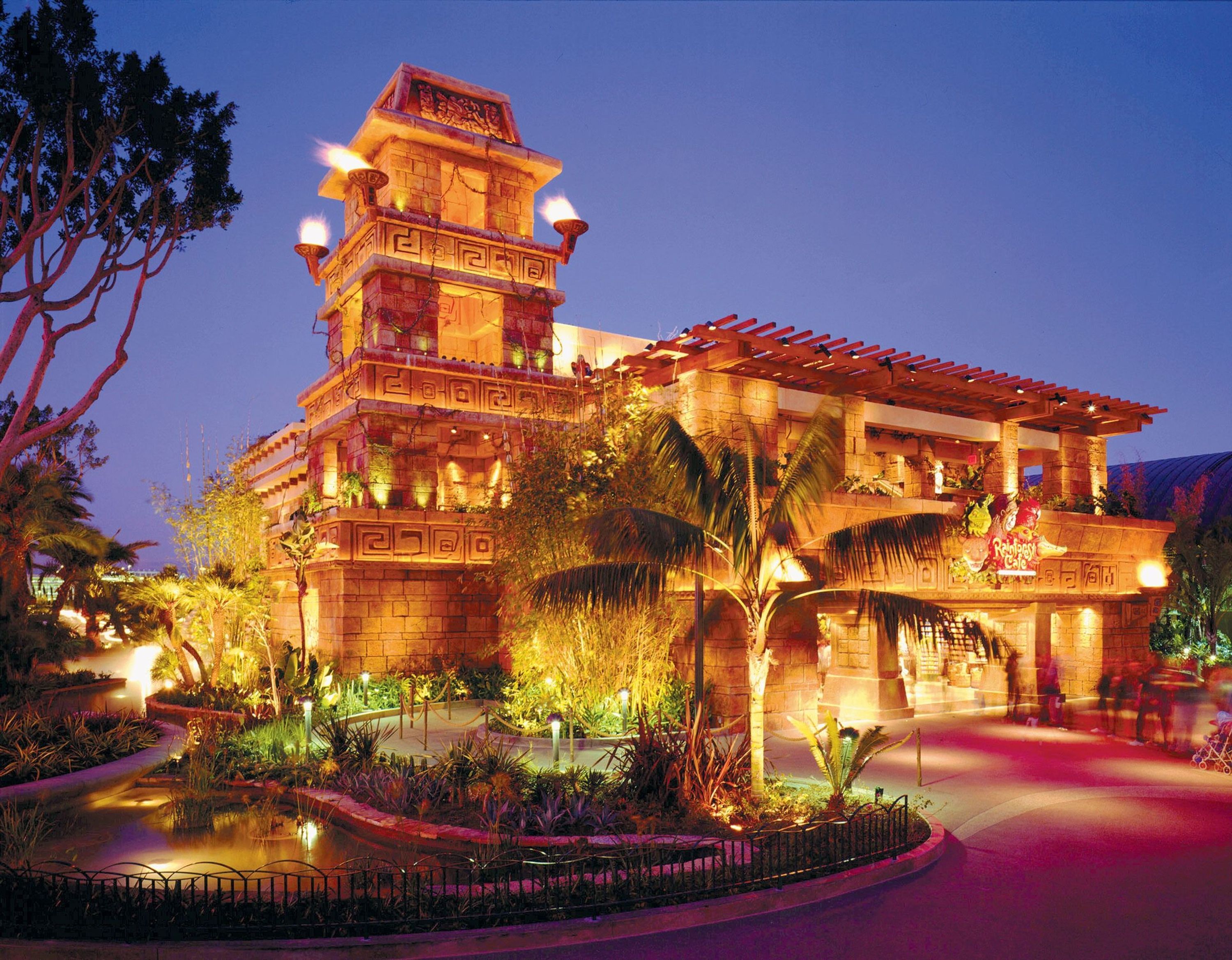
Schuler Shook Lore: Our roots in theatrical lighting and scenic design were a boon for the design trends of the 90s, and Schuler Shook became one of the leading design firms for themed restaurants and immersive environments inspired by history and storytelling. Our work on the original Rainforest Café in 1994 led to the design of 46 more locations around the globe to this day, adding a theatrical flair to our projects.
Other notable themed restaurant projects followed, including Jekyll & Hyde Club, T‑Rex Cafe, and The Boathouse.
1995
Work is completed at Ravinia Festival Pavilion and the Civic Opera House, two major cultural venues in the Chicagoland area.
Notable Projects: Ravinia Festival Pavilion, Highland Park, IL; Civic Opera House, Chicago, IL
1996
Emily Klingensmith and Paul Whitaker join the firm as it expands into larger civic and cultural lighting and theatre work.
Notable Projects: State Street Lighting, Chicago, IL; Toys “R” Us Prototype, Minneapolis, MN
1997
The team completes lighting designs for several landmark public artworks across Chicago: the Chicago Picasso at Daley Center, Chagall’s Four Seasons Mosaic, and Calder’s Flamingo.
Notable Projects: Empire Theatre, San Antonio, TX; Arts Club of Chicago, Chicago, IL; Minneapolis City Hall, Minneapolis, MN
1998
Lighting design is completed for the historic Chicago Water Tower, one of the city’s most recognizable landmarks.
Notable Projects: Chicago Water Tower, Chicago, IL; Old St. Patrick’s Church, Chicago, IL
1999
The firm earns its first IALD Award for work at Shedd Aquarium. Giulio Pedota joins the firm as a Lighting Designer working out of Chicago.
Notable Projects: Second Street Bridge, Columbus, IN; Wild Reef Exhibit, Shedd Aquarium, Chicago, IL

Emily Klingensmith navigates sharks and spiders while aiming fixtures at Shedd Aquarium.

Schuler Shook Lore: One of our more adventurous projects, The Wild Reef Exhibit at Shedd Aquarium had our lighting designers focusing lights over a tank of live sharks and navigating the aquarium’s unfortunate escape of thousands of baby spiders from a faulty exhibit case.
Our lighting designers went on to receive an IALD Award for the project, as well as the lifelong respect of their peers for the unexpected encounters with arachnids.


As the decade drew to a close, no one knew quite what to expect. The new millennium was approaching, and advances in technology were reshaping the world faster than ever before.
We had no idea what was just around the corner for the firm, but the next chapter would prove transformative, bringing remarkable growth and opportunity.
2000 – 2010:
Landmark Projects,
Lasting Connections,
and a Growing Reach
By the start of the new millennium Schuler Shook was firmly established as a trusted voice in lighting design and theatre planning, continuing to grow as we took on larger projects, completed more international work, and hired more exceptional designers.


2000
The theatre planning practice expands with future partners Michael Burgoyne and Joshua Grossman joining the growing studio.
Notable Projects: Cafesjian’s Carousel, St. Paul, MN; Potawatomi Casino, Milwaukee, WI; Walter Peyton College Prep, Chicago, IL; Nationwide Arena, Columbus, OH; Herman Miller National Showroom, Chicago, IL
2001
Jack Hagler joins and establishes the Dallas – Fort Worth office; Todd Hensley is named Partner.
Notable Projects: Phoenix Symphony Hall, Phoenix, AZ; Burnsville Center, Burnsville, MN; Peggy Notebaert Nature Museum – Butterfly Haven, Chicago, IL

Schuler Shook Lore: Always a man ahead of his time, Jack Hagler joined the company in 2001 under the condition that he would work remotely from Texas. As the sole employee on the ground in the Lonestar state, Jack’s dining room table served as the first Dallas office.
2002
Ongoing work with the Hennepin Avenue Theatre District includes renovations to key historic venues in Minneapolis.
Notable Projects: Pantages Theatre, Minneapolis, MN; Franklin Institute, Philadelphia, PA; Avenue of the Arts Bridge, Minneapolis, MN
2003
Schuler Shook continued to expand the practice with major cultural projects across North America including the adaptive reuse of the historic Chicago Pumping Station into a new home for Lookingglass Theatre Company.
Notable Projects: Lookingglass Theatre Company, Chicago, IL; Marion Oliver McCaw Hall, Seattle, WA
2004
A landmark year including major civic and cultural projects and a brand refresh that refined the firm’s identity.
Notable Projects: Millennium Park, Chicago, IL; King’s Theatre, Brooklyn, NY; Boston Opera House, Boston, MA; Saenger Theatre, New Orleans, LA


Schuler Shook Lore: The Minneapolis office has always enjoyed multiple Michaels and marked a milestone around 2005 with five staff using the first name Michael and a sixth person with the last name Mikels. Schuler Shook has also had multiple Bobs, Jacks, and Jims over the years; but they’ve never matched the Michaels.
2005
The Dallas office transitions from a home-based setup into a formal studio in the historic Texas Moline Building as Kimberly Corbett Oates joins the team.
Notable Projects: Bigelow Chapel, New Brighton, MN; The Cue at The Guthrie, Minneapolis, MN; Detroit School of Arts, Detroit, MI
2006
Schuler Shook celebrates its 20th anniversary and hosts its first firm-wide “Exchange,” a 3‑day gathering bringing the entire team together to share perspectives, skills, and ideas.
Notable Projects: Victory Gardens Theatre, Chicago, IL; Houston Baptist University, Houston, TX; Meijer Majestic Theatre, Grand Rapids, Grand Rapids, MI

Schuler Shook Lore – Exchange Edition: In 2006 the firm held the first-ever “Exchange”: a firm-wide gathering where we share perspectives, skills, and ideas with each other. The first Exchange was held in Madison, WI with 35 staff in attendance. We continue this tradition today, with our most recent gathering in May of this year with 68 staff including 7 from Melbourne.
2007
Jim Baney is named Partner as the firm’s portfolio expands.
Notable Projects: Palmolive Building, Chicago, IL; Princeton University – Stanhope Hall, Princeton, NJ
2008
Jack Hagler is named Partner; the firm completes significant cultural projects across the U.S.
Notable Projects: David H. Koch Theater, New York, NY; W Minneapolis – Foshay Tower, Minneapolis, MN; MGM Grand at Foxwoods, Mashantucket, CT
2009
The Melbourne studio opens under Bob Shook and Jim Hultquist, supporting the Hamer Hall redevelopment and establishing the firm’s first international office.
Notable Projects: Jorge Prieto Math and Science Academy, Chicago, IL; Central Park Bandshell, Red Wing, MN

The Melbourne Studio:
While opening a studio in Melbourne wasn’t something Bob and Duane set out to do when the company was founded, the scale and complexity of the project at Hamer Hall called for a theatre consultant to be on the ground full time. Jim Hultquist was game, and the studio’s first home was a single desk within Arts Centre Melbourne itself.


2010 – 2020:
Expanding Horizons
The 2010s marked a new chapter for Schuler Shook. As the firm expanded into new cities and strengthened its U.S. and international presence, a new generation of leaders stepped forward to guide its future.


2010
The firm delivers civic and cultural work across multiple regions as its practice broadens.
Notable Projects: Harrah’s Cherokee Event Center, Cherokee, NC
2011
The Cowles Center opens in Minneapolis, once again strengthening long-standing ties to the Hennepin Avenue Theatre District.
Notable Projects: Cowles Center, Minneapolis, MN; Loyola University – Halas Recreation Center, Chicago, IL

Schuler Shook Lore: The Cowles Center, originally the historic Shubert Theatre, had to be relocated to a new lot down the street before being restored and adapted into a new performing arts center. It is the largest building to ever be moved via truck in one piece.
2012
The renovation of Hamer Hall at Arts Centre Melbourne is completed and the Melbourne studio is formally established with Jim Hultquist at the helm.
Notable Projects: Hamer Hall at Arts Centre Melbourne, Melbourne, VIC; Moody Performance Hall, Dallas, TX; The University of Chicago – Reva and David Logan Center for the Arts, Chicago, IL
2013
The Dallas office relocates downtown as the firm strengthens its national reach.
Notable Projects: Theatre School at DePaul University, Chicago, IL
2014
The firm delivers civic and infrastructure-focused cultural projects across the U.S.
Notable Projects: Target Field Station, Minneapolis, MN; The University of Wisconsin – Memorial Union, Madison, WI
2015
The San Francisco Bay Area office opens, and leadership transitions from the founders to the next generation of partners.
Notable Projects: Ordway Center for the Performing Arts, St. Paul, MN; Ulumbarra Theatre, Bendigo, VIC; Ascend Amphitheater, Nashville, TN
Schuler Shook Lore: In our 40 years, we’ve encountered many interesting spellings and pronunciations of the company name. We take it in stride, but we do have a running list we keep around that includes:
- Shuler Shook
- Schluler Shook
- Shooler Shuck
- Schuler’s Hook
- Schuler Schook
- Schlook Schuler
- Schuler Shoes
- Shula Shook
2016
The Minneapolis office moves to its new riverfront home along the Mississippi.
Notable Projects: Pillsbury A‑Mill, Minneapolis, MN; U.S. Bank Stadium “The Horn,” Minneapolis, MN; Chicago Riverwalk, Chicago, IL; John Hancock Building Lobby, Chicago, IL; Robinson Center, Little Rock, AR
2017
The firm completes a range of civic and cultural projects internationally.
Notable Projects: Cincinnati Music Hall, Cincinnati, OH; Minnesota State Capitol, St. Paul, MN; Hyatt Global Headquarters, Chicago, IL
2018
Project work spans cultural and institutional venues.
Notable Projects: McDonald’s Chicago Flagship, Chicago, IL; 7Seventy7, Milwaukee, WI
2019
Year 2019, the New York office is established by Ted Ohl, growing the firm’s presence in another major theatre and cultural market. Josh Grossman, Emily Klingensmith, and Giulio Pedota become Partners.
Notable Projects: Octave 9: Raisbeck Music Center, Seattle, WA; Macalester College Janet Wallace Fine Arts Center, St. Paul, MN; Sacramento Memorial Auditorium, Sacramento, CA; Dallas Holocaust and Human Rights Museum, Dallas, TX; Crested Butte Center for the Arts, Crested Butte, CO


2020-Present:
Evolving Together,
Shaping What’s Next
The 2020s began with unprecedented disruption, requiring new ways of working, collaborating, and supporting projects around the world. Through it all, Schuler Shook remained focused on serving clients, embracing new opportunities, and continuing to evolve.


2020
The firm shifts to remote work during the COVID-19 pandemic while maintaining project delivery worldwide and the formation of the Diversity, Equity, and Inclusion Committee.
Notable Projects: The Momentary, Bentonville, AR; Navy Pier Flyover, Chicago, IL; ACMI Renewal, Melbourne, VIC; Kim’s, Minneapolis, MN; Midway International Airport, Chicago, IL
Schuler Shook Lore: The Momentary opened one week prior to lockdown, but quickly adapted into a COVID-19 vaccination site, as well as place for community members to access supplies, food, and other support systems. Many of our projects found themselves in similar situations, adapting to support the safety of the greater community.
2021
Remote operations continue alongside delivery of major cultural projects. Kimberly Corbett Oates becomes a Partner.
Notable Projects: The Rady Shell at Jacobs Park, San Diego, CA; Dayton’s Project, Minneapolis, MN; Victorian Pride Centre, St. Kilda, VIC; Tribune Tower Façade Lighting, Chicago, IL; Buddy Holly Hall of Performing Arts and Sciences, Lubbock, TX
2022
Garth Hemphill joins leadership to launch the audio video design service, and the firm returns to in-person work with a new Chicago office.
Notable Projects: James Earl Jones Theatre, New York, NY; Sydney Opera House Concert Hall, Sydney, NSW; IDS Crystal Court, Minneapolis, MN; Studebaker Theater, Chicago, IL; KLRU Austin TV Studio, Austin, TX; Orion Amphitheatre, Huntsville, AL
2023
The firm hosts its first in-person Exchange since 2019, reconnecting teams across offices.
Notable Projects: The Venue at Thunder Valley Casino, Lincoln, CA; Keith Bell Opportunity Central, Forney, TX; Scottsdale Civic Plaza, Scottsdale, AZ; The BayCare Sound Amphitheatre, Clearwater, FL; Diamond Head Theatre, Honolulu, HI
2024
Work continues across major civic and cultural developments across the globe.
Notable Projects: Jacobs Music Center, San Diego, CA; North Loop Green 360, Minneapolis, MN; 825 Arts, St. Paul, MN; Lakewood Welcome Center, Minneapolis, MN
2025
The firm delivers a diverse range of cultural and institutional projects, including collaborations with long-term clients on creating new facilities.
Notable Projects: St. Louis Symphony Orchestra Jack C. Taylor Music Center, St. Louis, MO; The Playwrights Center, St. Paul, MN; National Medal of Honor Museum, Arlington, TX; Caesar’s New Orleans Hotel & Casino, New Orleans, LA


2026
Forty years on, Schuler Shook reflects on its history while actively engaged in work across the world. We have already had the privilege of working on projects this year that reflect the breadth of experience, artistry, and passion that define our firm.
Our theatre planning team is contributing to the renovation of Roundabout Theatre’s Todd Haimes Theatre on Broadway, and has already celebrated the long-awaited openings of TimeLine Theatre in Chicago and Glasshouse Theatre at Queensland Performing Arts Centre in Brisbane, Queensland after years of dreaming, planning, and joyful collaboration.
Our lighting design work has come full circle as we complete new projects at familiar sites such as Pritzker Pavilion in Chicago’s Millennium Park. At the same time, we continue to illuminate environments around the world, advancing sustainability, wellness, and human-centered design in every project.
Meanwhile, our Audio Video Design practice continues to expand, pushing the boundaries of how technology can shape experiences across sectors and space types and revealing what is possible when technology, creativity, and artistry meet.
Together, these projects reflect a firm that remains curious, inventive, and committed to creating meaningful experiences through light, space, and sound.
In May the entire team gathered once again for Exchange, reflecting on our four decades of growth while looking toward the future.
As we enjoyed time together as a company, a persistent question was on our minds: In a world changing so quickly it’s sometimes hard to catch your breath, how do you plan for the future?
Across four decades, Schuler Shook has grown from two designers answering the phone into a multi-office practice shaping performance spaces, cultural institutions, and civic landmarks around the world.
But the through-line has remained remarkably consistent: curiosity, collaboration, and a willingness to take on work that doesn’t always come with a roadmap. From aardvarks to opera houses, from dining room offices to international studios — as well as an exorbitant number of Michaels — the firm’s history is less about a single trajectory and more about a steady accumulation of relationships, ideas, and creative problem-solving.
We have been privileged to be doing this work for 40 years and we’re grateful for everyone who has been a part of this journey.
We can’t wait for the next 40.
